Advertisement

Israeli minister on live tv admits that saudi arabia and egypt are giving it's full support to israe

Advertisement
But Allah helped Hamas and Palestinians and Israel had huge loses.

After few days war Israel had Billions Dollars loses. So that US has to come for additional Dollars help and immunition help to continue baby killings in Gaza.
 
Advertisement
Advertisement

SEE PALESTINES ZIDEEEEEEEEEEEEE LEADERS IN SUITS, IN AIRCONDITIONED HOTEL GAZA BEACH HOTELS, WITH THEIR MERCEDES DO NOT CARE ABOUT POOR PALESTININES OF GAZA


Last edited:
Confused Hari parsad......

If you are playing games .. that is OK....

but if you have pain in your heart for Hamas then you should respect Shia and Hezbollah that has always sided with Hamas.
YOu alos know Hamas also used Syrian-made M-302 Khaibar. So technically you supporting Syrian Current Shia king.

Now your post kind of direct its readers that you are supporting Hamas.. and if you support Hamas then your support Shia and Hasan Nasrallah

May i ask .. whats your game plan???? before you shoot me and chop my head off.
 
Advertisement
Advertisement

[TD="width: 548, align: left"] [/TD]
[TD="width: 11"] [/TD]
[TD="width: 2, bgcolor: black"][/TD]
[TD="width: 11"] [/TD]
[TD="width: 158"] [/TD]

[TD="align: left"]

[TD="width: 560, align: left"][/TD]
[/TD]


[TD="width: 116"]

[TD="width: 140"]

[TD="width: 116"]
[h=1]Nightlife in Gaza? First there should be a life[/h] The wealthy sit in cafes, those who have a little cash go to the beach, and those who do not have a penny to their name – lay on a mattress in the doorway of their house and watch the passersby. 'The day passes here as if you were in jail - you sleep, eat a little, and go back to sleep. Who would ever believe that once upon a time the guys would organize a party with dancers?'
Ali Waked

[TD="width: 306"]
Published: 08.20.07, 17:26 / Israel Culture

[TD="width: 102, align: left"]
facebook_lb_roof_eng.gif


[TD="width: 158, align: right"]
ws.gif
ws.gif
ws.gif
ws.gif
ws.gif
ws.gif
ws.gif
ws.gif
ws.gif
ws.gif

[TD="width: 59"][/TD]
[TD="width: 8"]
ws.gif
[/TD]
[/TD]

[TD="align: left"][/TD]
[/TD]

[TD="bgcolor: #cccccc"][/TD]

[TD="bgcolor: #FFFFFF"]
AKCF108_a.jpg
magdelet4_English.gif
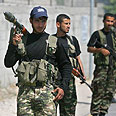
Hamas armed men Photo: AP

[TD="colspan: 2"]
3.png
Life in Green

[TD="align: left"] [TABLE="width: 116"]
[TR]

[/TD]
[/TD]

[/TD]
[/TD]
​

​
“The young people in Gaza not only do not have a night life, they have no life at all. They have nothing to dream about, and the entire day is centered on the nargila (water pipe) and sleep,” according to 24 year-old Ahmed, describing the dullness of everyday life in the Gaza Strip. In a conversation with Ynet, Ahmed estimated that the majority of young people in Gaza are unemployed “and without money you cannot talk about recreation or enjoyment, even if it is here in Gaza.”

Ahmed studied engineering in Egypt and Gaza, but his dreams of joining a construction company or setting up his own business collapsed with the latest upheaval. “The days pass as if you were in jail - you sleep, eat a little, and go back to sleep. At night, if you have a few liras, you can go to a caf to smoke a nargila. It has already been nine days since I have done anything. I just sleep.”

AKCF105_wa.jpg
Gaza beach. For those who can afford it (Photo: AP)

Ahmed’s father works for an international organization and the family’s economic situation is better than the average in Gaza, but even if he can allow himself to go out, “I do not have the energy.”
Nevertheless, what do the young people do for fun in Gaza?
“Generally there are three types of recreation: you can sit at the entrance to your house, go to the beach, or to the caf. Each of these activities is tied to your economic situation. If someone is really poor, he does not leave the house. If there is no Fatah activist in the neighborhood who really annoys the Hamas - a very dangerous situation - he simply lays a mattress in the doorway of the house and watches the passersby. That is his recreation.
“The second group includes the ones who go to the beach. They also do not have money. Four or five guys get together, buy a bag of tobacco for the nargila for NIS 14, even though before the revolution and the closures it would cost NIS 4, each person adds another NIS 2 for the cab and a kilo of charcoal and go down to the beach. They spend the night there until the sun comes up. The charcoal and tobacco can last for at least four days. This way everyone can have a good time for four or five days for NIS 6-7.
“The third group can afford going to cafes. Each outing costs NIS 6-7 for a nargila and drink. There are a few like me, who can take NIS 20-30 of pocket money from their mothers, and can go hang out at Caf Sultana which is considered above average. But this is only for a very select group, the children of the wealthy, whose parents work for the international organizations or are businessmen.”
It does not sound too exciting…
“That is how it is, not much we can do. Who would believe that once a few guys would have been able to organize a party with dancers in a hall, or even on the street? Can you imagine dancers on the streets of Gaza? That disappeared with the intifada, and now it seems unreal and incomprehensible.

"True, there are still exclusive places, where women do not really wear much clothes, and it is pleasant there because you feel like you are in Tel Aviv with people in minimal clothing, but this is only in a few hotels, and it is like a members-only club. The most important thing is that this can end up costing NIS 100-120 in places like the Beach Hotel and the Ritz.”

JEM109_wa.jpg
Passing the time in Gaza (Photo: AP)

In general, Ahmed said, Gaza and recreation do not really go together - not only because of the Modesty Patrol, but mostly because there is no money and nowhere to go.

“From Beit Hanoun in the north to Rafah in the south there is nothing besides the square in the presidential compound, the ambassadors’ complex, the wealthy Rimel neighborhood and the main square in the city. Once we used to go to square of the Unknown Soldier to watch girls who dared walk around in tight pants and without covering their hair, but this haa also ended. We did not do this out of abandonment, but rather because there was nothing else to do.”

Nevertheless, Ahmed said that some of the young people try to keep the “western look.” According to him, there are a lot of young people with gel in their hair, spiky hairstyles and tight pants.

“I personally keep up this appearance, mostly because I want to protest against those young people, who I call opportunists, who with the revolution changed their outer appearance and grew beards in the hope that Hamas will treat them well,” he said. “I am stubborn about my appearance, and I even grew out my side burns. If someone dares to bother me about my appearance, I will tell him that I think he is a hypocrite.”

What do you talk about when you get together and not spend the day sleeping?
“The only thing to talk about is the situation between Fatah and Hamas, and then you see the smoke of the nargila rising according to the crazy rhythm of the nerves. When we do not talk about that, we talk about how the situation is crappy and suffocating, and that is obviously connected to the first subject.
[TABLE="width: 300"]
[TR]
[TD="colspan: 3"][/TD]
​

​


​
“We have apparently given up on people’s aspirations. We do not talk about business, developments or studies. We only talk about passing the day in peace. Dreams? There are none. There is actually one dream, a dream that my friends and I share and I think all the young people here share as well - it is to get a visa to a normal country and to get out of here. As soon as possible.”
[/TD]
[/TD]
[/TR]
[/TABLE]
[/TD]
[/TR]
[/TABLE]
 
14 July 2014 Last updated at 12:18 ET

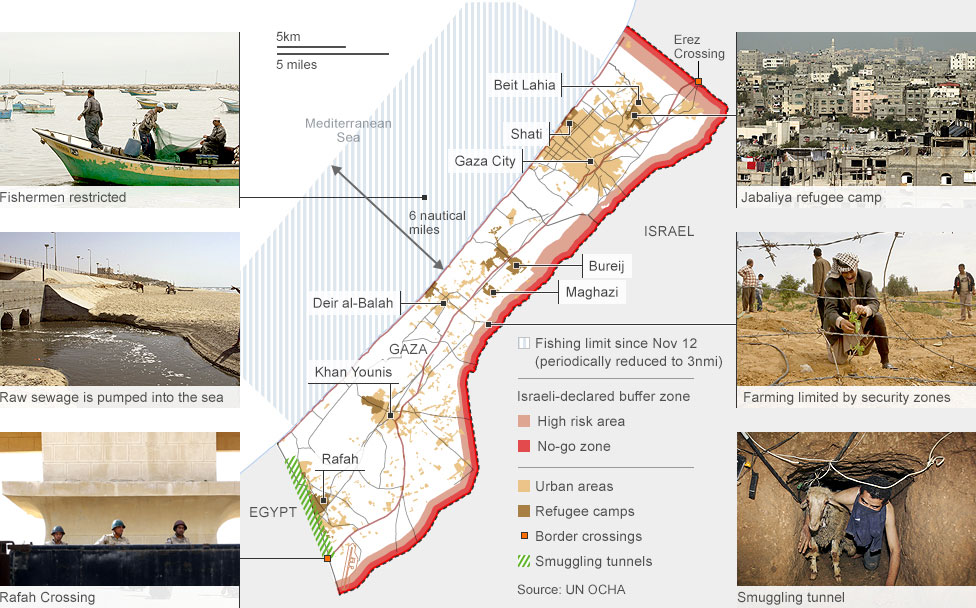
[h=1]Life in the Gaza Strip[/h] Home to 1.8 million people, Gaza is 40km (25 miles) long and 10km wide, an enclave bounded by the Mediterranean Sea, Israel and Egypt.
_76253499_life_in_gaza_976_v2.jpg

Continue reading the main story Originally occupied by Egypt, which retains control of Gaza's southern border, the coastal territory was captured by Israel during the 1967 Middle East war.
In 2005, Israel withdrew its troops and some 7,000 settlers.
A year later, the militant Islamist group Hamas won Palestinian legislative elections. It ruled Gaza from 2007 to 2014 following a violent rift with the rival Fatah faction of Palestinian Authority President Mahmoud Abbas.
When Hamas took over in Gaza, Israel swiftly imposed a blockade on the territory, restricting the movement of goods and people in and out. Egypt meanwhile blockaded Gaza's southern border.
_74982321_line976.jpg

FREEDOM OF MOVEMENT
_76256428_50ff977e-4e94-422d-a410-015f1b7f759f.jpg
Since Hamas came to power in Gaza in 2007, Egypt has largely kept its border with Gaza closed
Already limited, freedom of movement and access to Gaza were reduced significantly after mid-2013, when Egypt put new restrictions in place at the Rafah border crossing and launched a crackdown on the network of smuggling tunnels under the Egypt-Gaza border.
In the first half of 2013, 40,000 people were crossing each month at Rafah. From July to December 2013, the traffic was reduced to about 9,550 per month.
In recent years, Rafah had become the primary entry and exit point to Gaza for Palestinians as a result of Israeli restrictions at the Erez crossing in the north.
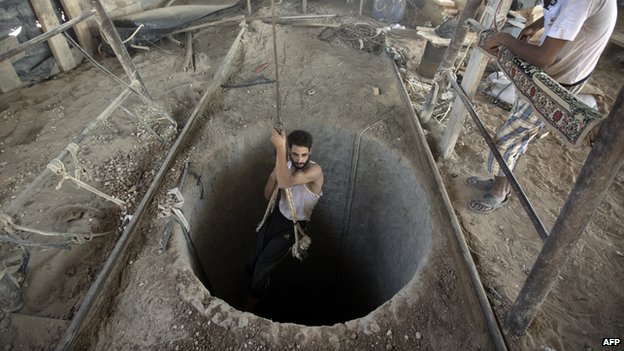
The smuggling tunnels had meanwhile proliferated after the tightening of the blockade of Gaza. They were used to import construction materials, livestock, fuel, food, cash and weapons.
The easing of the blockade in June 2010 saw the number of operating tunnels decrease from about 1,000 to approximately 200 to 300. Smugglers focused on transferring construction materials for the private sector and fuel that was cheaper to purchase in Egypt than Israel.
The crackdown on the tunnels that started in June 2013 resulted in an almost total halt in smuggling, triggering shortages of building materials and fuel, and a surge in the price of food.
_74982321_line976.jpg

ECONOMY
_76257050_180306052%281%29.jpg
Tunnels were dug under the Egyptian border to bring in all kinds of goods, and weapons
Gazans are, on average, worse off than in the 1990s. Twenty-one percent are in deep poverty, living on less than 1,832 shekels ($534; 313) a month, compared with 7.8% in the West Bank.
The unemployment rate in the Strip is 40.8%, significantly higher than in the West Bank. Of particular concern is the high youth unemployment rate, which stands at more than 50% in Gaza.
The Hamas-run economy ministry estimated that the crackdown on smuggling had cost Gaza's economy $460m in 2013. The reduction of revenue from tax collection on smuggling also led the government to delay the payment of salaries to Gaza's 50,000 civil servants.
The severe shortage of building materials led to a surge in prices and a sharp slowdown in the construction sector, which employs about 10% of the workforce. The fuel shortage saw meanwhile thousands of workers employed in the transport, fishing and agricultural sectors lose income.
_74982321_line976.jpg

EDUCATION
_76257045_177622610.jpg
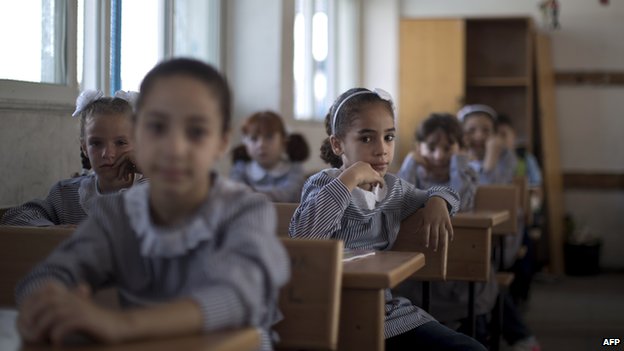
Many children attend schools run by the UN
Gaza's school system is under pressure. The UN, which runs many of the territory's schools, says an additional 440 schools are needed by 2020 to cope with the expected growth in the population.
Some 463,600 children attend 694 primary and secondary schools. To make up for the shortage of educational facilities, 67% of government and 71% of UN schools run on double shifts, limiting instruction time. Classes are also large, with anywhere between 40 to 50 pupils in each.
This has led to shorter school days and lower enrolment in the secondary system. Training and vocational opportunities are also few and far between. That said, official figures for literacy are high; 93% for women, 98% for men.
Thirteen schools are located in areas near the Gaza-Israel fence which often see clashes between Israeli troops and Palestinian militants.
_74982321_line976.jpg

POPULATION
_76256432_e99a57f9-f2e1-470a-80f1-641c05a91db3.jpg
Some of Gaza's refugee camps lack basic amenities
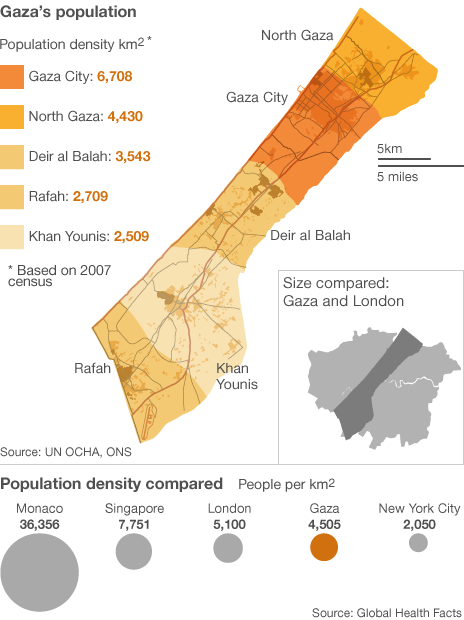
Gaza's population is expected to grow to 2.13 million by the end of the decade.
This will also result in an increase in the population density which is already one of the highest in the world. On average, some 4,505 people live on every square kilometre in Gaza. That's expected to rise to 5,835 people per square kilometre by 2020.
The UN says there is a shortage of 70,000 housing units due to natural population growth, as well as the damage caused by Israel's ground offensive in December 2008-January 2009. Some 12,000 people remain displaced after the destruction of their homes.
The ratio of young people between the ages of 15 and 29 to the total over-15 population is exceptionally high, at 53%. This leads to a high dependency rate.
Should the economy pick up there will be plenty of young people of working age. But if not, there is the potential for social tension, violence and extremism, according to the UN.
_76252675_gaza_population_464.gif

_74982321_line976.jpg

HEALTH
_76257218_139129374.jpg
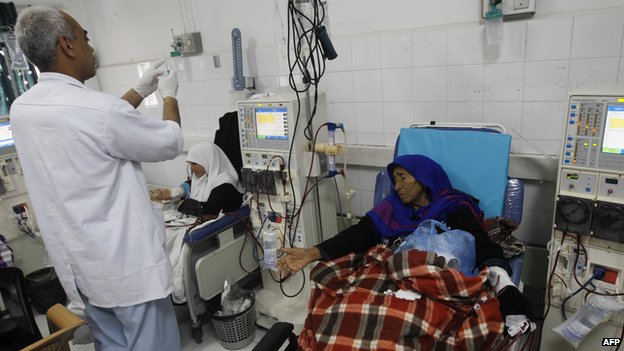
Electricity and fuel shortages have disrupted the functioning of medical facilities
The UN says that while health indicators in Gaza are comparable to middle and high-income countries, quality needs to be improved. It says most health facilities are unable to provide adequate care and need to be upgraded.
Access to public health services has worsened as a result of the measures adopted by the Egyptian authorities in mid-2013, according to the UN.
The closure of the Rafah crossing reduced the number of patients travelling to Egypt for treatment from a monthly average of 4,146 to 305, with only very sick people or special cases allowed to enter, and disrupted the supply of critical medicines. Gaza's ministry of health had previously depended on Egypt to treat 20% of its outside referrals and for 25% of its drug supplies.
Since 2008 Israel has increased the number of medical cases it allows in from Gaza for treatment.
Egypt's closure of smuggling tunnels led to severe fuel and electricity shortages that disrupted the functioning of medical facilities. Frequent and prolonged power cuts strained hospitals' back-up power sources, affecting medical equipment and leading to interrupted or postponed treatment.
_74982321_line976.jpg

FOOD
_76256430_bbd1b9a1-5687-4fb2-a591-ffaf613cb223.jpg
Not so long ago, Gaza had a thriving fishing industry
The level of food insecurity in Gaza increased from 44% to 57% between 2012 and 2013. Eighty per cent of Gaza's population receive some form of food aid as few have sufficient money to pay for their basic needs.
Israeli restrictions on access to agricultural land and fishing add to the challenges.
Gazans are also not allowed to farm in the Israeli-declared buffer zone - 1.5km (0.9 miles) wide on the Gaza side of the border - and this has led to a loss in production of an estimated 75,000 tonnes of produce a year. The restricted area coincides with what is considered Gaza's best arable land.
Following the November 2012 ceasefire agreement between Israel and Hamas, the fishing limit was extended from three nautical miles to six. However, it has been periodically reduced to three nautical miles in response to rocket fire from Gaza. Israeli naval forces frequently open fire towards Palestinian fishing boats approaching or exceeding the limit. The UN says if the limit was lifted, fishing could provide employment and a cheap source of protein for the people of Gaza.
_74982321_line976.jpg

POWER
_76256891_187763701.jpg
Power cuts in Gaza disrupt almost all aspects of daily life
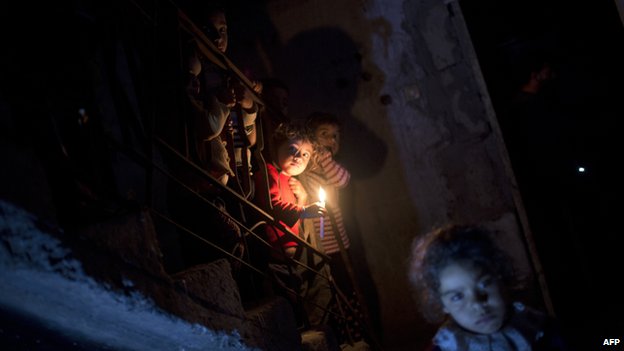
Power cuts are an every-day occurrence in Gaza. It gets most of its power from Israel together with further contributions from Gaza's only power plant and a small amount from Egypt. However, this is less than its current needs.
Many homes have their own generators, but fuel is extremely expensive to buy.
The shortage of fuel caused by the Egyptian crackdown on smuggling affected the production of electricity at the Gaza Power Plant (GPP), which had become dependent on cheap Egyptian diesel.
After depleting its reserves, the plant was forced to shut down for 43 days in late 2013, triggering lengthy power outages and severely disrupting the provision of basic services, including health, main water and sanitation facilities. The plant resumed operations after the Palestinian Authority bought fuel from Israel with funds donated from Qatar. There was a shorter outage in March 2014.
Offshore there is a gas field which the UN says could provide all the territory's power needs if it was developed. Any surplus could be ploughed into development.
_74982321_line976.jpg

WATER AND SANITATION
_76256886_456000223.jpg
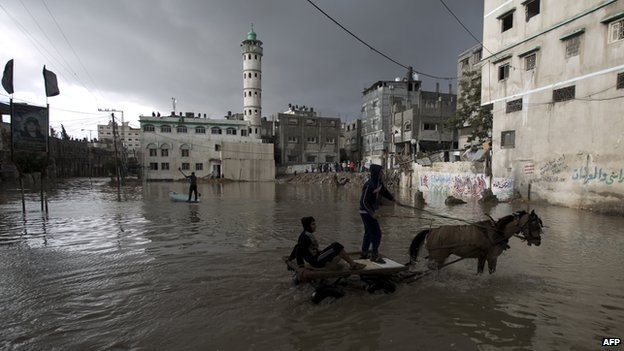
Heavy rainfall in December 2013 overwhelmed Gaza's storm water and sewage systems
Gaza has little rain and no major fresh water source to replenish it underground water supplies which are not large enough to keep up with demand.
Salt from the sea has seeped into underground supplies raising salination levels above acceptable levels for drinking water. Only 5.5% of the piped water meets World Health Organisation (WHO) quality standards and some 340,000 people in the Strip were forced to consume drinking water of unacceptable quality in 2013, according to the UN.
Treatment of waste water and sewage is another headache. Gaza relies on waste water treatment plants that are either working beyond their capacity or were constructed as temporary installations for partial treatment. As a result, about 90 million litres of untreated or partially treated sewage is pumped into the Mediterranean Sea every day, creating pollution, public health hazard and problems for the fishing industry.
The shutdown of Gaza's power plant in November 2013 due to a fuel shortage and the inability of waste water treatment plant operators to keep their generators running led to the release of sewage into the storm water system and the flooding of sewage stations.
When winter storm Alexa struck the next month, inundating the storm water system with rainfall, entire areas across Gaza were flooded with a mixture of sewage and storm water, creating public health concerns.

 

[h=2]Palestine Tourism[/h]
[h=1]Forbidden love on Gaza beach[/h] advertisement above

beach.jpg
Image via photobucket.com


By Hazel Heyer, eTN Staff Writer | Jul 10, 2009 It seems Palestine, too, has taken a more conservative approach towards local tourists and residents going to the beach, walking along Gaza shores and showing public display of affection. Apparently, Hamas police attempted to arrest 26-year-old freelance reporter Asma al-Ghoul walking with a man along the Gaza beach. The group of friends consisted of two women and three men passing time, walking on the northern Gaza shore.
Miss al-Ghoul was picked up by police on charges of indecent clothing and behavior. On the night of the arrest, she was wearing jeans and T-shirt - attire that is considered fairly provocative in Gaza’s conservative society and which could have easily attracted the attention of the plain-clothed Hamas vice police who patrol the beaches. She also swam in pants, fully dressed, with a girlfriend. Al-Ghoul’s male friends were beaten by Hamas police, kept in jail for several hours and asked to sign statements saying they would not violate public moral standards again, she said. The incident came as a surprise, worst yet, as shock to Palestinians who, for the first time were told about the news and apparent new Islamic law imposed by Hamas on the coastal area.
According to local news, this incident was the first time Hamas has openly tried to punish a woman for behaving in a way it views as un-Islamic since seizing power two years ago. The incident follows months of quiet pressure on Gaza’s overwhelmingly conservative 1.4 million residents to abide by its strict religious mores. The Hamas even ordered shop-owners to tear down ads showing silhouettes of women's bodies on display and pull lingerie off the shelves.
Ironically, the Islamic hardliner’s stance comes to fore – a “culture” imported from ultra-conservative Saudi Arabia (where couples/ lovers innocently strolling on the beach or streets risk getting arrested by the religious police or Mutawa), while Gaza’s beaches are promoted to boost local tourism.
Not long ago, after Gaza’s disengagement, Palestinian tourism experts pinned their hopes high on internal or domestic tourism. One way of tapping the numbers on the Strip was to reintroduce Gaza’s beaches to the people of Palestine. Beaches were getting a lot of attention at the time.
For instance, Gaza’s Deir Al Balah is known for its beautiful beaches, golden bright sand, year-round sunshine; also great seafood, quality dates and ancient archaeology. The local destination has attracted native family vacationers and honeymooners in the midst of widespread instability. People from the West Bank thronged Gaza’s shores.
One serious issue Gaza tourism faces is increasing tourism traffic to Gaza, which has no access - neither from the sea nor air, not even land through Egyptian or Israeli borders. “It’s just inaccessible,” said a tourism adviser for former chief Bandak. “If we can only open and use the airport and seaport, the border crossings between Egypt and Gaza and Israel and Gaza, we will have some traffic. But people from Gaza just go through the fence out of a gate illegally. This boundary is closed off. If we all open the borders, tourists will flow freely,” he said.
About 32 km north of the Egyptian border, on the western Mediterranean coast, Gaza has become the economic hub for its citrus fruits and other produce, hand-woven carpets, wicker furniture and pottery, also fresh seafood. Several restaurants and parks lined the Mediterranean strip of Gaza, considered one of the most historic towns in the world. Nightlife in Gaza was vibrant and offered visitors fun evenings of entertainment, music and dance at the beachfront hotels.
Even ancient Gaza was a prosperous trade center and a stop on the caravan route between Egypt and Syria. First inhabited by the Canaanites and occupied by Egypt in the 15th century BC, it became a Philistine City several hundred years later. Around 600AD, it was captured by the Muslims. Gaza is mentioned a number of times in the Bible, especially as the site where Samson brought down the Philistine temple on himself and his enemies. Muslims believe it to be the site where Prophet Mohamed’s grandfather was buried. Consequently, it became an important Islamic center until the early 12th century when it was occupied by the Crusaders who built churches. Gaza, however, returned to Muslim control in 1187.
What had happened to al-Ghoul could be a reflection of a return to strict Muslim control of Gaza.
Meanwhile in a separate development, over 2,400 homes were destroyed in Gaza during the Israeli attack from December to January - 490 of them by F-16 air strikes. On top, 30 mosques, 29 educational institutions, 29 medical centers, 10 charitable organizations and 5 cement factories were also bombed. The Free Gaza boat named Spirit of Humanity was sent from Cyprus to aid the victims; there were 21 human rights and solidarity workers representing 11 different countries onboard who arrived. Passengers included Nobel laureate Mairead Maguire and former US congresswoman Cynthia McKinney. The ship carried three tons of medical aid, children's toys, and rehabilitation and reconstruction kits for twenty family homes.
Although over $4 billion in aid was promised to Gaza in the aftermath of the violent attacks, little humanitarian aid and no reconstruction supplies have been allowed in.
 
[h=1]The Palestine Entries: Photos of Gaza at night[/h] June 26, 2011 by Sami Kishawi 7 Comments
// Entry #11
I enjoy bright city lights and the hustle and bustle of a metropolitan area during the evening, but Gaza City’s nightlife surpasses my every desire.
In Chicago, very rarely will you see entire families walking through the streets or enjoying picnics in city parks after midnight. But in Gaza, the city is most alive during the night. Teenage boys lounge in coffeeshops and pass around hookah pipes. Children in dusty sandals kick soccer balls at each other in dimly-lit side streets. Families sit around fountains in the heart of neighborhood parks. Ice cream shops struggle to keep up with the growing lines. Street vendors sell neon lights, children’s toys, or salted watermelon seeds. The festive atmosphere lasts all night and begins all over again the very next day.
Nighttime photography is difficult for me, but it had to be done.
If they aren’t already out, families leave their homes at sunset and head toward busy ice cream shops or crowded but calm gardens. This is a view from my room’s window.
This is the same view as the previous photograph except that the sun is now completely set. Gaza has a mysterious orange glow to it. The bright lights at the bottom left corner come from Kazem, Gaza City’s most famous ice cream shop.
This is a street view of Kazem. Note the large packs of customers this shop attracts.
This building houses various television channel offices as well as a few coffeeshops which can be seen illuminated by bright colorful lights on the second floor. On the right is a small ducaana, the Arab equivalent of a corner store that sells everything from chocolate bars to screwdrivers to soccer balls to pickled carrots.
Even though it’s almost midnight, this toy store remains open to the public.
A street vendor sells nuts and seeds near a palm tree in the center of a public park.
Another street vendor sells bright and colorful toys in the center of a public park.
Horse carriages adorned with bright neon lights take families on rides through the city.
Isn’t this a beautiful city?