
- Joined
- Jun 25, 2013
- Posts
- 4,503
- Reaction score
- 1,123
- Points
- 113
The strange case of Kulbhushan Jadhav
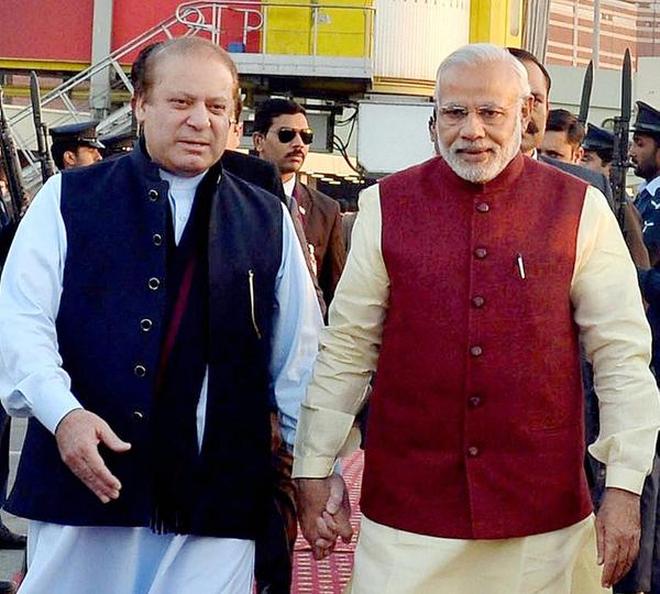
The current cycle of bilateral engagement and acrimony runs from the dramatic visit by Prime Minister Narendra Modi to Lahore on Christmas in 2015. The two leaders on that visit. PTI
Perhaps the backdrop explains the dynamics at play more than just details of his incarceration
The military trial and summary sentencing to death of Kulbhushan Jadhav in Pakistan, with theIndian High Commission denied consular access to him, has plunged India-Pakistan relations into a crisis again. Mr. Jadhav is not the first Indian to be caught and sentenced as a spy by Pakistan, but the first retired middle-level naval officer. The context and background of this need examination.
A diplomatic leap in the dark
The current cycle of bilateral engagement and acrimony runs from the dramatic visit by Prime Minister Narendra Modi to Lahore on Christmas in 2015. The occasion was Pakistan Prime Minister Nawaz Sharifs granddaughters wedding, but really it was a diplomatic leap in the dark. As in the past, beginning with Prime Minister Atal Bihari Vajpayees Lahore bus journey, theatrical moves rattle anti-India forces in thePakistani military and jihadi organisations, who then unleash retributive terrorist acts.
Within a week of Mr. Modi and Mr. Sharif socialising, the Pathankot airbase was attacked. Tragically, within days of that, Mufti Mohammad Sayeed, the Chief Minister of Jammu and Kashmir, who headed the Peoples Democratic Partys alliance with the Bharatiya Janata Party, died. The stage was set for instability in the Kashmir Valley.
While Mufti sahibs daughter Mehbooba Mufti dithered for nearly three months whether or not to succeed her father, the situation in Pakistan was drifting too. Prime Minister Sharif, marginalised by his namesake, the Pakistani Army chief, undermined by the Panama Papers revelations and suffering from heart trouble, left for the U.K. for medical treatment in April 2016. He returned to Pakistan in July. By then,Ms. Mufti had barely been in office when Burhan Wani, a self-styled commander of theHizbul Mujahideen, was killed, inflaming an already restive Valley. From that point onwards, Indo-Pak relations slid downwards.
Kulbhushan Jadhav alias Hussein Mubarak Patel was arrested by Pakistan in March 2016, allegedly in Balochistan, for espionage and abetting terror. This was a windfall for Pakistan as since the 2008 Mumbai attacks and the confessions of Pakistan-born American operative David Headley, it had been seeking moral equivalence by alleging complicity of Indias external intelligence agency, the Research and Analysis Wing (R&AW), in almost every major attack, particularly by the renegade Tehreek-e-Taliban Pakistan. In fact, the joint statement of Prime Ministers Manmohan Singh and Yousaf Raza Gilani at Sharm el-Sheikh in 2009 was widely condemned in India for unnecessarily allowing Pakistan to introduce Balochistan in the statement to discuss an alleged Indian hand in the Baloch uprising.
Gaps in stories
There is the usual Indo-Pak disagreement over facts. India claims Mr.Jadhav was conducting business out of Chabahar, Iran, for many years after retiring from the Navy, and that he has been abducted by Pakistani state or non-state actors from within Iran. The fact that despite specific provisions in the Vienna Convention on Consular Relations, India was denied access to Mr.Jadhav only confirms that Pakistan does not want the truth to be revealed about theplace and manner of arrest.
India also argues that spies and operatives are not sent carrying their own passports. On the other hand, it is unclear why Mr. Jadhav was operating under a Muslim name, and if he did convert, why thegovernment keeps referring to him by his earlier name. India has not challenged the authenticity of his passport, implying that it was not obtained by fraud or faked by Pakistan. With thedebate in India now enveloped in jingoism, such lacunae in stories paraded by both sides are beyond examination.
The truth may never be known, but Doval-isation of Indias approach to Pakistan has been obvious for some time. Prime Minister Modis espousal of thecause of Balochis and the residents of Gilgit from theramparts of the Red Fort on August 15, 2016 only confirmed Pakistani fears that India abets terror and secession in Pakistan. However, recent signals from Pakistan via Track IIevents were thatthe new Army chief, Gen. Qamar Javed Bajwa, wanted to reorient his Armys approach towards India and would endorse the civilian governments lead in crafting its Indiapolicy. He was apparently getting a pushbackfrom entrenched interests raised on India baiting.
There were unconfirmed reports that National Security Adviser Ajit Doval had spoken to his Pakistani counterpart to acknowledge the signal and create anenvironment for resuming political contact. Why then did Pakistan change tack and with sudden alacrity, devoid of transparency, sentence Mr.Jadhav?
One trigger could have been the disappearance ofan ex-ISI Pakistani military officer in Nepal. Another may be a desire to stoke further unrest in the Kashmir Valley. It could also be some re-balancing between the civilian and military authorities as Prime Minister Sharif awaits court judgement on the Panama Papers charges. At any rate, Pakistan has succeeded in capturing media space and the Indian governments attention and thus mainstreaming its grouses even as a new U.S. president shapes his foreign policy.
The Indian opposition has adopted a jingoistic pitch to entrap a government mixing politics, religion and nationalism. If assurances in Parliament are that thegovernment will do all in its power to rescue Mr. Jadhav, either it isconfident of a Cold War-style exchange of spies, provided they have managed to secure the asset that went missing from Nepal, orit isupping the ante hoping that Pakistan will not want to escalate tensionsfurther.
Indias perception of Pakistan
India misperceives Pakistan, as the 19th century French statesman Talleyrand said the world did Russia, as it is neither as strong as it seems nor as weak as we think. For instance, it is not isolated, as policymakers in South Block assume. Pakistan would have seen rising Chinese rhetoric over theDalai Lamas visit to Tawang. It also would read U.S. President Donald Trumps intervention in Syria and the dropping of the mother of all bombs in Afghanistan as the U.S. returning to business as usual and restoring the primacy of its Sunni allies, i.e. Turkey, Saudi Arabia, plus the Gulf Cooperation Council, Pakistan, and Egypt. Pakistan is familiar with the generals now ruling the roost after White House chief strategist Stephen Bannons fall.
A Sino-Pak alliance now fed by Chinas open hostility and not countered by the U.S.s words of restraint may entrap India into a regional morass. Many assumptions on which the Modi government has functioned in diplomacy are being rewritten. The challenge is to steer India through this maze with more than jingoism, theatre, and domestic electoral needs.
K.C. Singh is a former diplomat.
comment from thread launcher :
India does not want Pakistan to take any decisive action on kashmir , water issue , India , Iran or afghanistan Machinations and they want to give our army a thousand stabs each followed by diploomacy . This is not possible . War is very likely in the subcontinent if India and its ally Iran continue this policy. I am certain of war if Modi stops our water .
Source
Last edited by a moderator:


