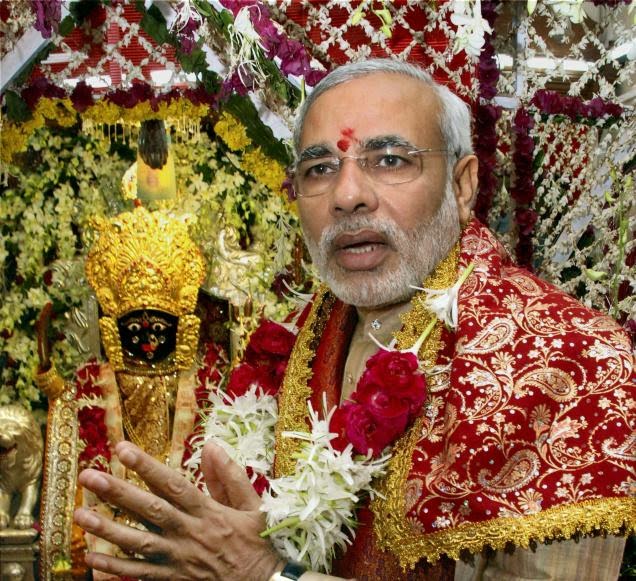
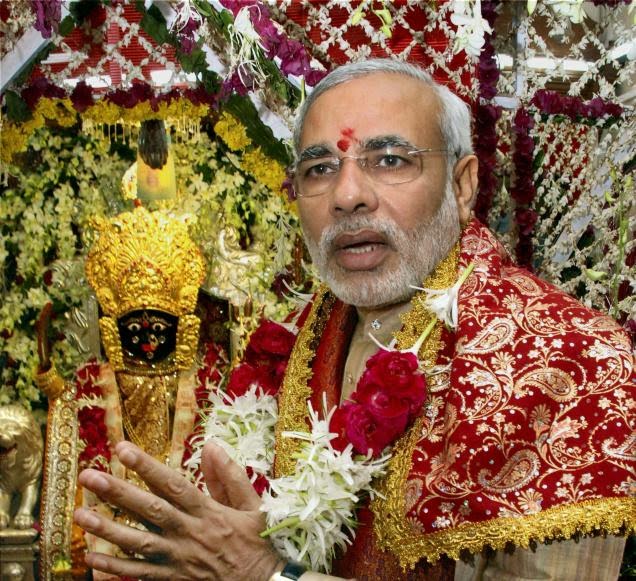
There have been serious questions raised about India's secularism since its independence in 1947. Such questions have gained new urgency with the rapid rise of Hindu Nationalists and the election of BJP leader Narendra Modi in 2014.
Serious doubts about India's claim of secularism were articulated well by Indian journalist Kapil Komireddy in an Op Ed piece he wrote for the UK's Guardian newspaper a few years ago. Here's an excerpt of it:
"Indian Muslims in particular have rarely known a life uninterrupted by communal conflict or unimpaired by poverty and prejudice. Their grievances are legion, and the list of atrocities committed against them by the Indian state is long. In 2002 at least 1,000 Muslims were slaughtered by Hindu mobs in the western state of Gujarat in what was the second state-sponsored pogrom in India (Sikhs were the object of the first, in 1984). Gujarat's chief minister, Narendra Modi, explained away the riots by quoting Newton's third law. "Every action," he said on television, "has an equal opposite reaction." The "action" that invited the reaction of the mobs was the torching of a Gujarat-bound train in which 59 Hindus pilgrims, most of them saffron-clad bigots who were returning home from a trip to the site of the Babri Mosque that they had helped demolish a decade earlier, perished. The "equal and opposite reaction" was the slaughter of 1,000 innocent Muslims for the alleged crime of their coreligionists."
Komireddy goes on to describe how India's "liberal" elite rationalize sectarianism in "secular" India:
"The novelist Shashi Tharoor tried to burnish this certifiably sectarian phenomenon with a facile analogy: Indian Muslims, he wrote, accept Hindu rituals at state ceremonies in the same spirit as teetotallers accept champagne in western celebrations. This self-affirming explanation is characteristic of someone who belongs to the majority community. Muslims I interviewed took a different view, but understandably, they were unwilling to protest for the fear of being labelled as "angry Muslims" in a country famous for its tolerant Hindus."
The Sangh Parivar's project to Hinduize India has accelerated with the landslide victory of BJP leader Narendra Modi and his inauguration as Prime Minister of India in 2014. Some of the manifestations of this phenomenon as reported by the Washington Postare as as follows:
1.The Vishwa Hindu Parishad (or the World Hindu Council) launched a program called “Gharwapsi” (or Homecoming) to urge India’s Muslims and Christians to convert to Hinduism, which they said was the religion of their ancestors. It has resulted in many reported instances of forced mass conversions of Christians and Muslims to Hinduism.
2. Beef sales have been banned in several Indian states. The most egregious of such laws is the Maharashtra state law that criminalizes possession or consumption of beef.
3. Foreign Minister Sushma Swaraj has said the Hindu scripture Bhagwad Gita must be declared a “national scripture.” Another BJP politician, Manohar Lal Khattar, the chief minister of the northern Haryana state has said Bhagwad Gita is considered more important than India’s secular Constitution.
4. Poor school children are being denied eggs, a cheap protein needed by growing youngsters, in their school lunches by India's vegetarian Hindu elite, according an NPR report.
The above changes are just the tip of a much larger iceberg of Hindu transformation of India with major appointments of Hindu ideologues by ruling party to key positions in education and media posts at the center and the provinces.
It's not just in India that the Hindu Nationalists are gaining strength. Their programs receive significant funding and support from non-resident Indians (NRIs). A report entitled "Hindu Nationalism in the United States: A Report on Non-Profit Groups" makes the following assertions regarding the strength and nature of the Hindu nationalist movement in the United States:
a. Over the last three decades, a movement toward Hinduizing India--advancing the status of Hindus toward political and social primacy in India-- has continued to gain ground in South Asia and diasporic communities. The Sangh Parivar (the Sangh "family"), the network of groups at the forefront of this Hindu nationalist movement, has an estimated membership numbering in the millions, making the Sangh one of the largest voluntary associations in India. The major organizations in the Sangh include the Rashtriya Swayamsevak Sangh (RSS), Vishwa Hindu Parishad (VHP), Bajrang Dal, and Bharatiya Janata Party (BJP).
b. Hindu nationalism has intensified and multiplied forms of discrimination, exclusion, and gendered and sexualized violence against Muslims, Christians, other minorities, and those who oppose Sangh violations, as documented by Indian citizens and international tribunals, fact-finding groups, international human rights organizations, and U.S. governmental bodies.
c. India-based Sangh affiliates receive social and financial support from its U.S.-based wings, the latter of which exist largely as tax-exempt non-profit organizations in the United States: Hindu Swayamsevak Sangh (HSS), Vishwa Hindu Parishad of America (VHPA), Sewa International USA, Ekal Vidyalaya Foundation-USA. The Overseas Friends of the Bharatiya Janata Party - USA (OFBJP) is active as well, though it is not a tax-exempt group.
Acceleration of "secular" India's total Hindu-ization under Prime Minister Modi represents a sea change for South Asia region and the world. It could prove to be verydestabilizing for India, a much larger and far more diverse country than its neighboring Islamic Pakistan. Such instability could derail India's economic rise unless its forced Hindu-ization is checked by the country's leadership with external pressure from India's friends. And its effects will be strongly felt far outside the borders of India. It is already causing serious issues between India and Pakistan that could lead a devastating war in South Asia with severe consequences for the entire world.
This is just crazy, instead of 'ache din' it seems like the world is headed towards "bure din" .....God help everyone in the Subcontinent with the rise of such ideology !!:biggthumpup:
News that Indian Prime Minister Narendra Modi is slated to hobnob with the Bay Area’s leading tech executives has sparked outrage among human rights advocacy groups.
National advocacy group Sikhs For Justice plans to protest Modi’s visit at Facebook’s Menlo Park headquarters on Sunday morning and, later in the day, outside the SAP Center.
The group argues that Modi’s tenure as Indian's leaader has resulted in deteriorating religious freedom for its citizens. They allege that he is aggressively trying to turn the world’s largest democracy into a Hindu nation through forced conversion of Muslims and Christians.
Sikhs For Justice has also offered a $10,000 reward to anyone who poses specific questions to Zuckerberg and Modi regarding the latter’s treatment of Sikhs.
"We urge everyone to remind [Facebook CEO Mark] Zuckerberg that hosting a known human rights violator runs counter to the core American value of upholding religious freedom,” said Gurpatwant Singh Pannun, an attorney and legal advisor for Sikhs For Justice.
Modi, who was in the United States last September, is slated to visit Tesla and Google and meet with Indian-American startup founders. He believes that the technological innovation that these companies are known for can help to raise the standard of living in India.
The SAP center is expected to be at full capacity for Sunday evening's event. More than 45,000 people requested tickets to hear Modi speak, but the arena can only hold 18,000. Video screens will be set up outside to accommodate those who were unable to secure a spot inside.`
Indian radicalization would not effect their chances to economic glory. It's because USA and thereby its followers Europe, Japan, Australia and Gulf countries have decided to develop her economically and militarily to make her stand to China. And we all know when they decide so then may it be Israel or India, radicalization or religeous fundamentalizm does not make a difference to them. And secondly we also know that indian fundamentalism is only against muslims not the White man.
This is just crazy, instead of 'ache din' it seems like the world is headed towards "bure din" .....God help everyone in the Subcontinent with the rise of such ideology !!:biggthumpup:
Independent intellectuals attacked by Sangh Parivar assassins in #India as #Hindu fundamentalism grows under #Modi http://fw.to/CLvDTvk
Kalburgi, who vocally opposed the Hindu practice of idol worship, is the latest secular thinker to be assassinated in South Asia. His slaying late last month raises questions about freedom of expression and highlights the growing might of religious fundamentalists across the region.
Hours after Kalburgi was killed, Bhuvith Shetty, a member of the Hindu militant group Bajrang Dal, tweeted in celebration: "Mock Hinduism and die a dog's death. And dear K.S. Bhagwan you are next."
Karnataka boasts one of India's highest literacy rates and includes the technology hub of Bangalore, but it is also home to deeply conservative Hindu groups. Last month in the coastal city of Mangalore, a group of Hindu men spotted a Muslim man speaking with a Hindu woman. They tied him to a pole, stripped him and beat him for nearly an hour, according to police.
Two other high-profile rationalists, Narendra Dabholkar and Govind Pansare, were shot point-blank 18 months apart in the western state of Maharashtra.
Dabholkar, a 68-year-old activist who worked on behalf of villagers exploited by local gurus and so-called godmen, campaigned for the state government to pass an anti-superstition bill. It's been two years since he was killed in the city of Pune, and no one has been charged.
"Fundamentalism in India is growing by the day across religions," Nayak said. "They feel they can scare us into submission but are completely mistaken. The anti-superstition movement in Maharashtra grew stronger after Dabholkar's assassination.
"As far as I am concerned, I would rather die speaking my mind instead of letting disgraceful things unfold in front of my eyes."
This is just crazy, instead of 'ache din' it seems like the world is headed towards "bure din" .....God help everyone in the Subcontinent with the rise of such ideology !!:biggthumpup:
India offers a startling example of this change, and its explosive political consequences. Half of that country’s component states now have sub-replacement fertility rates comparable to Denmark, or even lower. Meanwhile, some very populous states (like vast Uttar Pradesh or Bihar) retain the old Third World model. That stark schism is the essential basis for any understanding of modern Indian politics. As we might have predicted, the high fertility states are firmly and traditionally religious, and provide the base for reactionary and even fascist Hindu supremacist movements. Those currents are quite alien to the “European” low fertility states, located chiefly in the south, which tend to be secular-minded, progressive, and tolerant. Balancing those different regions would pose a nightmarish choice for any government, but the current Hindu nationalist BJP regime aligns decisively with the high fertility regions that provide its electoral bastions. The lesson is grim, but obvious: when you have to choose between two such distinct demographic regions, it is overwhelmingly tempting to turn to the one with all the voters, and all the young party militants. Invest in growth!
---------
High-fertility eastern Turkey is of course much more religious than the secular west, and this is where we find the Qur’an Belt that so regularly supports Islamic and even fundamentalist causes. It simply makes electoral sense for the government to respond to the interests of that populous growing area, and to drift ever more steadily in Islamist directions.
But there is a complicating fact. Those fast-breeding eastern regions are also home to what the Turkish government euphemistically calls the “Mountain Turks,” but which everyone else on the planet calls “Kurds.” Turkey’s Kurdish minority, usually estimated at around 15-20 percent of the population, is expanding very rapidly—to the point that, within a generation or two, it will actually be a majority within the Turkish state. This nightmare prospect is front and center in the mind of Turkish president Recep Tayyip Erdogan, who a couple of years ago issued an apocalyptic warning of a national Kurdish majority no later than 2038. That date is a little implausibly soon, but the principle stands.
In the face of seemingly imminent demographic catastrophe, what can Turkey do? One solution is for the government to plead with citizens to start breeding again—even those western secularists—and to get the national fertility rate closer to 3 than 2. But since that outcome is highly unlikely, the government must resort to short term solutions, and to extol religious, Islamic identities over ethnicity. Ideally, a return to Islam might even provide an incentive for families to reassert traditional values, and to have more children. Alongside that policy, the government has an absolute need to suppress stirrings of Kurdish nationhood or separatism on Turkish soil.
From a demographic perspective, the Turkish government is going to find any manifestations of Kurdish identity terrifying, far more than even the hardest-edged Islamism. ISIS is an irritant; the Kurds pose an existential demographic threat.
And in large measure, that explains why Turkish jets are targeting the Kurdish PKK militias, rather than ISIS.
Similar to Zia’s Pakistan, apart from creating an atmosphere where those who uphold a scientific temper are physically attacked and even killed (for instance the murder of anti-superstition activist Govind Pansare in Maharashtra in February last year), the government has also appointed Hindutva supporters with questionable academic credentials as heads of scientific institutions. There have also been instances of public funds used for researching ‘Hindutva science’. This raises the important question that many are asking: Is the Hindutva brigade aiming for the creation of a ‘Hindu Pakistan’?
“By contaminating science with absurd claims based on an ultra-nationalist political project, these self-proclaimed scientists are out to make the society regressive,” says Gauhar Raza, a scientist and poet based in Delhi. “Religious epics are narrated to younger generations as historical truths. This is exactly what happened in Pakistan.”
Similar to Zias Pakistan, apart from creating an atmosphere where those who uphold a scientific temper are physically attacked and even killed (for instance the murder of anti-superstition activist Govind Pansare in Maharashtra in February last year), the government has also appointed Hindutva supporters with questionable academic credentials as heads of scientific institutions. There have also been instances of public funds used for researching Hindutva science. This raises the important question that many are asking: Is the Hindutva brigade aiming for the creation of a Hindu Pakistan?
By contaminating science with absurd claims based on an ultra-nationalist political project, these self-proclaimed scientists are out to make the society regressive, says Gauhar Raza, a scientist and poet based in Delhi. Religious epics are narrated to younger generations as historical truths. This is exactly what happened in Pakistan.
Similar to Zia’s Pakistan, apart from creating an atmosphere where those who uphold a scientific temper are physically attacked and even killed (for instance the murder of anti-superstition activist Govind Pansare in Maharashtra in February last year), the government has also appointed Hindutva supporters with questionable academic credentials as heads of scientific institutions. There have also been instances of public funds used for researching ‘Hindutva science’. This raises the important question that many are asking: Is the Hindutva brigade aiming for the creation of a ‘Hindu Pakistan’?
“By contaminating science with absurd claims based on an ultra-nationalist political project, these self-proclaimed scientists are out to make the society regressive,” says Gauhar Raza, a scientist and poet based in Delhi. “Religious epics are narrated to younger generations as historical truths. This is exactly what happened in Pakistan.”
spreading of scientific temper is done with spread of education . by and large hindus have been superstitious but not very rigid as hindu religion have been changing through generations , many reform movements with coming of islam changed hindu religion, same thing happened with coming of english education and christian missionaries . to day hindus have become progressive with effect of socialism and western influence after people started going abroad.
this hindu radicalisation has been taking place only to capture power ,it has nothing to do with psyche of superstition or bacwardness.
Three murders, a suicide and a rash of political appointments at universities have thrown Indian academia into an uproar against the conservative (right-wing) government. Prominent artists, writers, historians and scientists are speaking out against an intensifying climate of religious intolerance and political interference in academic affairs.
“What’s going on in this country is really dangerous,” says Rajat Tandon, a number theorist at Hyderabad Central University. Tandon is one of more than 100 prominent scientists, including many heads of institutions, who signed a statement protesting “the ways in which science and reason are being eroded in the country.” The statement cites the murder of three noted rationalists — men who had dedicated their lives to countering superstition and championed scientific thought — and what they see as the government’s silent complicity.
Prime Minister Narendra Modi leads the Bharatiya Janata Party (BJP), which won the 2014 general elections in India in a landslide victory. The BJP and Modi, in particular, are aligned with the extremist right-wing group Rashtriya Swayamsevak Sangh, or RSS. (This unholy alliance is comparable to the relationship between the Republican Party and the Tea Party, but the RSS is a paramilitary group with more violent overtones than the Tea Party has shown so far.) Together, the BJP and RSS promote the agenda of Hindutva, the notion that India is the homeland of Hindus and all others — the hundreds of millions of Muslims, Christians, Sikhs and others in this sprawling, secular democracy — are interlopers.
“The present government is deviating from the path of democracy, taking the country on the path to what I’d call a Hindu religious autocracy,” says Pushpa Mittra Bhargava , who founded the prestigious Centre for Cellular & Molecular Biology in Hyderabad.
Despite his blatantly anti-secular stance, Modi’s stated goals for economic development are wildly popular, particularly among the country’s majority Hindus. But academics and intellectuals have been protesting the erosions on academic freedom almost from the start.
In January 2015, at the 102nd session of the Indian Science Congress, several members of the BJP government led a session on ancient Indian science and claimed that thousands of years ago, Indians had built planes that could fly not just on earth but between planets. There were other outlandish claims — that the elephant-headed Hindu god Ganesha is proof that Indian ancients knew the secrets of cosmetic surgery, for example. Scientists were dismayed, and some did call for the session to be canceled, but their primary response then was still ridicule, rather than outrage.
In February 2015, economics Nobel Laureate Amartya Sen stepped down as chancellor of Nalanda University in Bihar, protesting the “considerable government intervention” in academic decisions. That same month, gunmen attacked a left-wing politician called Govind Pansare and his wife; Pansare later died of his injuries. Then, in August, gunmen killed Malleshappa Kalburgi, a leading scholar and rationalist, at his home. “They were a threat, so they were eliminated,” says Tandon.
The attacks shocked the academic community and ignited protests from writers, filmmakers and historians; many returned their national awards as a symbol of their dissent.
Scientists were late to the table, which is not surprising, given that most of Indian science relies on government funds. Still, in October, three separate groups of scientists made statements — the total signatories now number nearly one thousand — protesting the government’s inaction against the acts of violence. (Bhargava returned his Padma Bhushan, one of the highest civilian awards in India, to the president.)
Last year, a professor at the Indian Science Congress, in Mumbai, claimed that India possessed airplanes seven thousand years ago. He isn’t alone in such beliefs. When a certain swathe of India’s population considers the country’s ancient past, it doesn’t see a country fragmented into kingdoms, savaged by caste divisions, and mired in poverty; rather, what’s envisioned is a vast, unified Hindu empire stretching from Kashmir to the Indian tip at Kanyakumari. This imagined entity brims with characters from Indian epics and spits out grand inventions that would put scientists in the twenty-first century to shame—not only airplanes but cars, plastic surgery, and stem-cell research. What these Indians see, in other words, is an India that was once greater than any other nation on earth, and which has since fallen into a cruddy, postcolonial despair. Muslim and British invaders, they insist, have sapped the subcontinent’s energies over the past millennium.
This is a major strand of the nativist philosophy espoused by Prime Minister Narendra Modi and the flotilla of parties and social organizations that escorted him to power, in 2014. It is, in the rippling and echoing way of world events, in step with archaic right-wing movements everywhere—Make India Great Again would be a suitable slogan—and it is untroubled by facts. In the past year, right-wing mobs have lynched and beaten Muslims and Dalits (the former untouchables, who have often refused to be co-opted by upper-class-dominated Hindu nationalism) in Delhi, Haryana, Uttar Pradesh, Gujarat, Madhya Pradesh, and Jharkhand for allegedly eating beef, a crime that these nationalists cannot condone after a millennium of their religion’s supposed persecution. (Hinduism has always been the majority religion on the subcontinent.) Dormant laws in Indian states banning cow-slaughter and beef consumption are now being enforced. In January, a Dalit Ph.D. student at Hyderabad University hanged himself from the ceiling fan in his room after right-wing groups bore down on him for his activism. Elsewhere, emboldened nationalist groups have intimidated fiction writers, scholars, and publishers into silence for wounding religious sentiments. Student protests are branded “anti-national” and slapped with sedition charges.
In India, right now, the past is violently alive, and it is being bandied about like a blunt instrument, striking down those who try to speak sense to the present or who try to point out that this past is itself a fiction.
One of the intellectuals involved in calling the right’s bluff is the Indian scholar Sunil Khilnani, who has just published an incisive work of popular history, “Incarnations: India in Fifty Lives.” Where the opposition is clamorous, the book is calm; where the opposition flexes its Vedic muscles, the book is undercutting, irreverent, and impish. It attempts to show, through prodigious but lightly worn scholarship, how complex and heterodox the Indian past was, and how it has been, and continues to be, constructed.
Khilnani begins with the Buddha, who lived around 500 B.C.E., and is thus, Khilnani writes, the “first individual personality we can recognize in the subcontinent’s history,” as well as an apostle of neutrality and nonviolence. The Buddha’s religion has receded in India, except as a balm to the Dalits, who escaped into it, and as a self-help tool for a sliver of the upper classes, who have embraced it the way that some people in the West do. Buddha prefigures many of the themes in the book. A sheltered man, he is moved by his first encounter with suffering, and leaves behind his wealthy family to wander India in the thrall of slowly budding new ideas. He is serene and centered amid violence. He is open-minded and against sects in a Brahmin-dominated society. He calls for a total reinvention of Hinduism—one that becomes its own religion.....