
- Joined
- Aug 21, 2014
- Posts
- 1,818
- Reaction score
- 768
- Points
- 0

Iraq War Vet: "We Were Told to Just Shoot People, and the Officers Would Take Care of Us"
Wednesday, 07 April 2010 15:02
By Dahr Jamail, t r u t h o u t | Report | name.
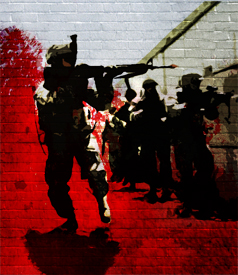
http://truth-out.org/archive/compon...people-and-the-officers-would-take-care-of-us
(Image: Lance Page / t r u t h o u t; Adapted: The U.S. Army, K. OS, whiteblot)
On Monday, April 5, Wikileaks.org posted video footage from Iraq, taken from a US military Apache helicopter in July 2007 as soldiers aboard it killed 12 people and wounded two children. The dead included two employees of the Reuters news agency: photographer Namir Noor-Eldeen and driver Saeed Chmagh.
The US military confirmed the authenticity of the video.
The footage clearly shows an unprovoked slaughter, and is shocking to watch whilst listening to the casual conversation of the soldiers in the background.
As disturbing as the video is, this type of behavior by US soldiers in Iraq is not uncommon.
Truthout has spoken with several soldiers who shared equally horrific stories of the slaughtering of innocent Iraqis by US occupation forces.
"I remember one woman walking by," said Jason Washburn, a corporal in the US Marines who served three tours in Iraq. He told the audience at the Winter Soldier hearings that took place March 13-16, 2008, in Silver Spring, Maryland, "She was carrying a huge bag, and she looked like she was heading toward us, so we lit her up with the Mark 19, which is an automatic grenade launcher, and when the dust settled, we realized that the bag was full of groceries. She had been trying to bring us food and we blew her to pieces."
The hearings provided a platform for veterans from Iraq and Afghanistan to share the reality of their occupation experiences with the media in the US.
Washburn testified on a panel that discussed the rules of engagement (ROE) in Iraq, and how lax they were, to the point of being virtually nonexistent.
"During the course of my three tours, the rules of engagement changed a lot," Washburn's testimony continued, "The higher the threat the more viciously we were permitted and expected to respond. Something else we were encouraged to do, almost with a wink and nudge, was to carry 'drop weapons', or by my third tour, 'drop shovels'. We would carry these weapons or shovels with us because if we accidentally shot a civilian, we could just toss the weapon on the body, and make them look like an insurgent."
Hart Viges, a member of the 82nd Airborne Division of the Army who served one year in Iraq, told of taking orders over the radio.
"One time they said to fire on all taxicabs because the enemy was using them for transportation.... One of the snipers replied back, 'Excuse me? Did I hear that right? Fire on all taxicabs?' The lieutenant colonel responded, 'You heard me, trooper, fire on all taxicabs.' After that, the town lit up, with all the units firing on cars. This was my first experience with war, and that kind of set the tone for the rest of the deployment."
Vincent Emanuele, a Marine rifleman who spent a year in the al-Qaim area of Iraq near the Syrian border, told of emptying magazines of bullets into the city without identifying targets, running over corpses with Humvees and stopping to take "trophy" photos of bodies.
"An act that took place quite often in Iraq was taking pot shots at cars that drove by," he said, "This was not an isolated incident, and it took place for most of our eight-month deployment."
Kelly Dougherty - then executive director of Iraq Veterans Against the War - blamed the behavior of soldiers in Iraq on policies of the US government.
"The abuses committed in the occupations, far from being the result of a 'few bad apples' misbehaving, are the result of our government's Middle East policy, which is crafted in the highest spheres of US power," she said.
Michael Leduc, a corporal in the Marines who was part of the US attack on Fallujah in November 2004, said orders he received from his battalion JAG officer before entering the city were as follows: "You see an individual with a white flag and he does anything but approach you slowly and obey commands, assume it's a trick and kill him."
Bryan Casler, a corporal in the Marines, spoke of witnessing the prevalent dehumanizing outlook soldiers took toward Iraqis during the invasion of Iraq.
"... on these convoys, I saw Marines defecate into MRE bags or urinate in bottles and throw them at children on the side of the road," he stated.
Scott Ewing, who served in Iraq from 2005-2006, admitted on one panel that units intentionally gave candy to Iraqi children for reasons other than "winning hearts and minds.
"There was also another motive," Ewing said. "If the kids were around our vehicles, the bad guys wouldn't attack. We used the kids as human shields."
In response to the WikiLeaks video, the Pentagon, while not officially commenting on the video, announced that two Pentagon investigations cleared the air crew of any wrongdoing.
A statement from the two probes said the air crew had acted appropriately and followed the ROE.
Adam Kokesh served in Fallujah beginning in February 2004 for roughly one year.
Speaking on a panel at the aforementioned hearings about the ROE, he held up the ROE card soldiers are issued in Iraq and said, "This card says, 'Nothing on this card prevents you from using deadly force to defend yourself'."
Kokesh pointed out that "reasonable certainty" was the condition for using deadly force under the ROE, and this led to rampant civilian deaths. He discussed taking part in the April 2004 siege of Fallujah. During that attack, doctors at Fallujah General Hospital told Truthout there were 736 deaths, over 60 percent of which were civilians.
"We changed the ROE more often than we changed our underwear," Kokesh said, "At one point, we imposed a curfew on the city, and were told to fire at anything that moved in the dark."
Kokesh also testified that during two cease-fires in the midst of the siege, the military decided to let out as many women and children from the embattled city as possible, but this did not include most men.
"For males, they had to be under 14 years of age," he said, "So I had to go over there and turn men back, who had just been separated from their women and children. We thought we were being gracious."
Steve Casey served in Iraq for over a year starting in mid-2003.
"We were scheduled to go home in April 2004, but due to rising violence we stayed in with Operation Blackjack," Casey said, "I watched soldiers firing into the radiators and windows of oncoming vehicles. Those who didn't turn around were unfortunately neutralized one way or another - well over 20 times I personally witnessed this. There was a lot of collateral damage."
Jason Hurd served in central Baghdad from November 2004 until November 2005. He told of how, after his unit took "stray rounds" from a nearby firefight, a machine gunner responded by firing over 200 rounds into a nearby building.
"We fired indiscriminately at this building," he said. "Things like that happened every day in Iraq. We reacted out of fear for our lives, and we reacted with total destruction."
Hurd said the situation deteriorated rapidly while he was in Iraq. "Over time, as the absurdity of war set in, individuals from my unit indiscriminately opened fire at vehicles driving down the wrong side of the road. People in my unit would later brag about it. I remember thinking how appalled I was that we were laughing at this, but that was the reality."
Other soldiers Truthout has interviewed have often laughed when asked about their ROE in Iraq.
Garret Reppenhagen served in Iraq from February 2004-2005 in the city of Baquba, 40 kilometers (about 25 miles) northeast of Baghdad. He said his first experience in Iraq was being on a patrol that killed two Iraqi farmers as they worked in their field at night.
"I was told they were out in the fields farming because their pumps only operated with electricity, which meant they had to go out in the dark when there was electricity," he explained, "I asked the sergeant, if he knew this, why did he fire on the men. He told me because the men were out after curfew. I was never given another ROE during my time in Iraq."
Emmanuel added: "We took fire while trying to blow up a bridge. Many of the attackers were part of the general population. This led to our squad shooting at everything and anything in order to push through the town. I remember myself emptying magazines into the town, never identifying a target."
Emmanuel spoke of abusing prisoners he knew were innocent, adding, "We took it upon ourselves to harass them, and took them to the desert to throw them out of our Humvees, while kicking and punching them when we threw them out."
Jason Wayne Lemue is a Marine who served three tours in Iraq.
"My commander told me, 'Kill those who need to be killed, and save those who need to be saved'; that was our mission on our first tour," he said of his first deployment during the invasion.
"After that the ROE changed, and carrying a shovel, or standing on a rooftop talking on a cell phone, or being out after curfew [meant those people] were to be killed. I can't tell you how many people died because of this. By my third tour, we were told to just shoot people, and the officers would take care of us."
When this Truthout reporter was in Baghdad in November 2004, my Iraqi interpreter was in the Abu Hanifa mosque that was raided by US and Iraqi soldiers during Friday prayers.
"Everyone was there for Friday prayers, when five Humvees and several trucks carrying [US soldiers and] Iraqi National Guards entered," Abu Talat told Truthout on the phone from within the mosque while the raid was in progress. "Everyone starting yelling 'Allahu Akbar' (God is the greatest) because they were frightened. Then the soldiers started shooting the people praying!"
"They have just shot and killed at least four of the people praying," he said in a panicked voice, "At least 10 other people are wounded now. We are on our bellies and in a very bad situation."
Iraqi Red Crescent later confirmed to Truthout that at least four people were killed, and nine wounded. Truthout later witnessed pieces of brain splattered on one of the walls inside the mosque while large blood stains covered carpets at several places.
This type of indiscriminate killing has been typical from the initial invasion of Iraq.
Truthout spoke with Iraq war veteran and former National Guard and Army Reserve member Jason Moon, who was there for the invasion.
"While on our initial convoy into Iraq in early June 2003, we were given a direct order that if any children or civilians got in front of the vehicles in our convoy, we were not to stop, we were not to slow down, we were to keep driving. In the event an insurgent attacked us from behind human shields, we were supposed to count. If there were thirty or less civilians we were allowed to fire into the area. If there were over thirty, we were supposed to take fire and send it up the chain of command. These were the rules of engagement. I don't know about you, but if you are getting shot at from a crowd of people, how fast are you going to count, and how accurately?"
Moon brought back a video that shows his sergeant declaring, "The difference between an insurgent and an Iraqi civilian is whether they are dead or alive."
Moon explains the thinking: "If you kill a civilian he becomes an insurgent because you retroactively make that person a threat."
According to the Pentagon probes of the killings shown in the WikiLeaks video, the air crew had "reason to believe" the people seen in the video were fighters before opening fire.
Article 48 of the Geneva Conventions speaks to the "basic rule" regarding the protection of civilians:
"In order to ensure respect for and protection of the civilian population and civilian objects, the Parties to the conflict shall at all times distinguish between the civilian population and combatants and between civilian objects and military objectives and accordingly shall direct their operations only against military objectives."
What is happening in Iraq seems to reflect what psychiatrist Robert Jay Lifton calls "atrocity-producing situations." He used this term first in his book "The Nazi Doctors." In 2004, he wrote an article for The Nation, applying his insights to the Iraq War and occupation.
"Atrocity-producing situations," Lifton wrote, occur when a power structure sets up an environment where "ordinary people, men or women no better or worse than you or I, can regularly commit atrocities.... This kind of atrocity-producing situation ... surely occurs to some degrees in all wars, including World War II, our last 'good war.' But a counterinsurgency war in a hostile setting, especially when driven by profound ideological distortions, is particularly prone to sustained atrocity - all the more so when it becomes an occupation."
Cliff Hicks served in Iraq from October 2003 to August 2004.
"There was a tall apartment complex, the only spot from where people could see over our perimeter," Hicks told Truthout, "There would be laundry hanging off the balconies, and people hanging out on the roof for fresh air. The place was full of kids and families. On rare occasions, a fighter would get atop the building and shoot at our passing vehicles. They never really hit anybody. We just knew to be careful when we were over by that part of the wall, and nobody did **** about it until one day a lieutenant colonel was driving down and they shot at his vehicle and he got scared. So he jumped through a bunch of hoops and cut through some red tape and got a C-130 to come out the next night and all but leveled the place. Earlier that evening when I was returning from a patrol the apartment had been packed full of people."
- Featured Thumbs
- http://archive.truthout.org/files/images/040710-6_0.jpg


