A report sees the US slipping below India and China in a ranking of the world's most powerful economies
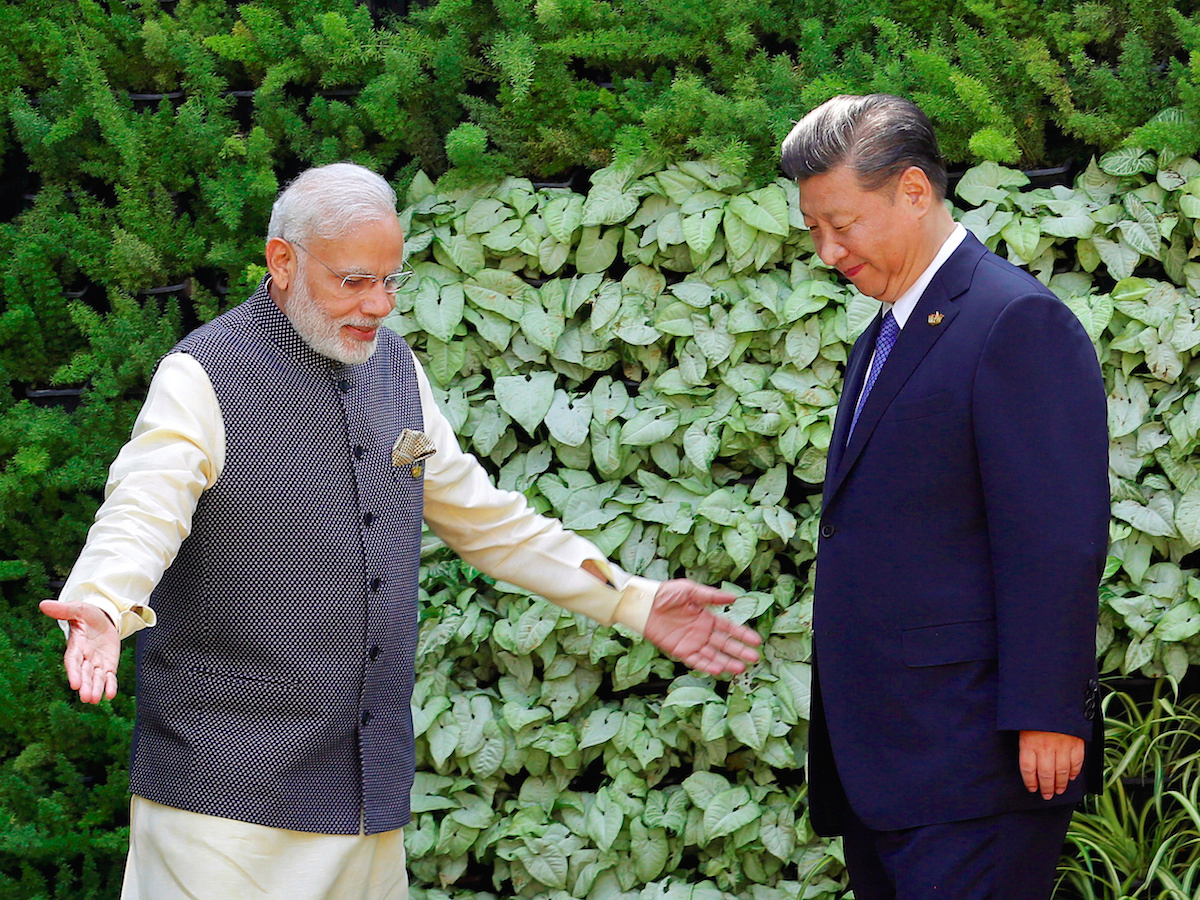
Indian Prime Minister Narendra Modi with Chinese President Xi Jinping. Reuters
China has already surpassed the US as the most powerful economy in the world by purchasing power parity, but India will also overtake the US by 2050, according to a report by the professional-services giant PwC.
In a report titled "The long view: how will the global economic order change by 2050?" PwC ranked 32 countries by their projected global gross domestic product, measured by purchasing power parity.
Macroeconomists use PPP to determine the economic productivity and standards of living among countries.
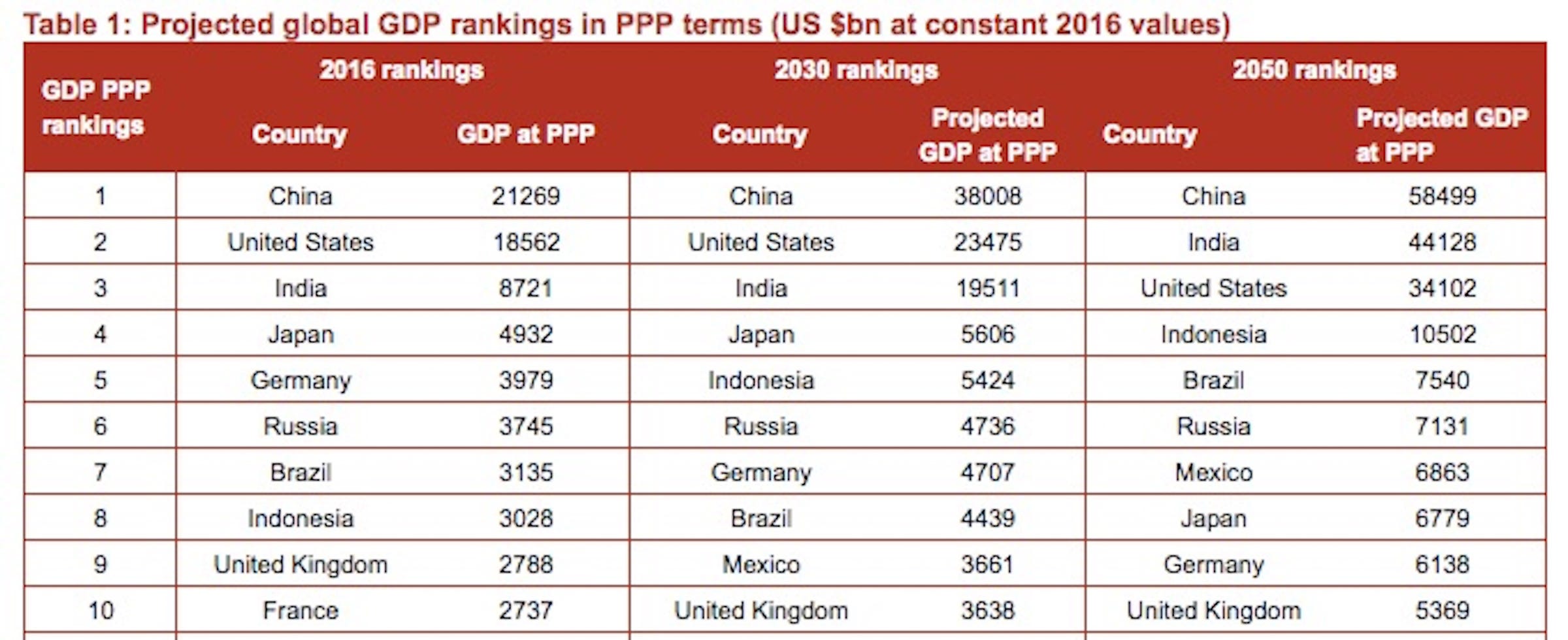
As of 2016, India was in third place in PwC's table with a PPP of $8.721 trillion, but by 2050 it is projected to grow to a huge $44.128 trillion. If you look at the following table, you can see how the growth rate of some emerging-market economies are seen to leap past some of their developed-market counterparts:
PwC
"Emerging economies offer great opportunities for business the numbers in our report make it clear that failure to engage with these markets means missing out on the bulk of economic growth we expect to see in the world economy between now and 2050," said John Hawksworth, the chief economist at PwC. "To succeed, businesses will need to adopt strategies with the right mix of flexibility and patience to ride out the short-term economic and political volatility that is a normal feature of emerging markets as they mature."
PwC predicts that another emerging-market economy, Indonesia, will move up the rankings and overtake Europe's powerhouse economy Germany and even Russia by 2050.
The world economy will double in size by 2042, PwC forecasts, "growing at an average annual rate of just over 2.5% between 2016 and 2050."
"Growth is expected to be driven largely by emerging market and developing countries, with the E7 economies of Brazil, China, India, Indonesia, Mexico, Russia and Turkey growing at an annual average rate of 3.5% over the next 34 years, compared to an average of just 1.6% for the advanced G7 nations of the US, Canada, France, Germany, Italy, the UK and Japan," the firm added.
Hawksworth said, however: "The global economy faces a number of challenges to prosperous economic growth in the long-term. Ageing populations and climate change require forward-thinking policy which equips the workforce to continue to make societal contributions later on in life and promotes sustainable development.
"Falling global trade growth, rising inequality and increasing global uncertainties are intensifying the need to create diversified economies which offer opportunities for everyone in a broad variety of industries."
[h=3]Key findings[/h]This report sets out our latest long-term global growth projections to 2050 for 32 of the largest economies in the world, accounting for around 85% of world GDP. Key results of our analysis (as summarised also in the accompanying video) include:
The world economy could more than double in size by 2050, far outstripping population growth, due to continued technology-driven productivity improvements
Emerging markets (E7) could grow around twice as fast as advanced economies (G7) on average
As a result, six of the seven largest economies in the world are projected to be emerging economies in 2050 led by China (1st), India (2nd) and Indonesia (4th)
The US could be down to third place in the global GDP rankings while the EU27’s share of world GDP could fall below 10% by 2050
UK could be down to 10th place by 2050, France out of the top 10 and Italy out of the top 20 as they are overtaken by faster growing emerging economies like Mexico, Turkey and Vietnam respectively
But emerging economies need to enhance their institutions and their infrastructure significantly if they are to realise their long-term growth potential.
The economies of emerging market minnows Egypt and Pakistan could surpass the Canadian economy by 2050, according to a “brave” new report by management consultancy PricewaterhouseCoopers.
“By 2050, emerging economies such as Mexico and Indonesia are likely to be larger than the UK and France, while Pakistan and Egypt could overtake Italy and Canada,” PWC said in a report published Tuesday.
The findings — based on gross domestic product purchasing power parity (PPP) terms — also forecasts India will replace the United States as the world’s second largest economy after China by 2050.
According to the measure, Canada is currently ranked as the 17th largest economy, but by 2030 the country will slip to No. 18 and by 2050 to No. 22. Egypt will move to No. 15 place and Pakistan right behind it.
Despite the Canadian economy’s diminished status, the country’s GDP will roughly double to US$3.1 trillion by 2050 from its current level.
The PWC forecast seems incredulous as Egypt’s GDP based on the more common market exchange rates (MER) stood at US$340 billion and Pakistan a mere US$284 billion in 2016.
By contrast, Canada’s US$1.5 trillion massive economy placed it as the 10th largest in the world.
By PWC’s MER measure, Canada’s GDP will slip to No. 17 by 2050, only narrowly beating both Egypt (No. 18) and Pakistan (19).
PWC argues that the PPP method is more appropriate for long-term forecasts as “price levels are significantly lower in emerging economies so looking at GDP at PPPs narrows the income gap with the advanced economies compared to using market exchange rates.”
The consultancy notes that “it might seem brave to opine on economic prospects for 2017, let alone 2050,” after a year of major political shocks with the Brexit vote and the election of President Donald Trump.
“However, I still think it is important to take a longer term view of global economic prospects that looks beyond the short-term ups and downs of the economic and political cycle, which are indeed very difficult to forecast,” wrote John Hawksworth, chief economist, PwC UK in the report.
Instead, the consultancy focused on fundamental drivers of growth, such as demographics and productivity, which in turn is driven by technological progress and diffused through international trade and investment, Hawksworth said.
Canada is not the only developed economy losing ground to emerging economies on the world stage. Japan would lose its coveted fourth spot to Indonesia by 2050, according to PWC. Germany, United Kingdom and France will also make way for rising economic powers Brazil, Russia, and Mexico to be among the Top 10 largest economies.
PWC warns that while emerging countries may benefit from strong population growth, their progress will depend on being able to generate enough jobs for young people in their countries.
“If they cannot do this, it could be a cause of political instability. For all these countries, therefore, our projections should be seen as indicating the potential for growth, rather than a guarantee that this potential will be realised,” PWC warned.
While some emerging economies will likely stumble and fail to realize their potential, the overall tilt towards emerging economies is unlikely to be interrupted thanks to their surging, young populations, and massive infrastructure requirements and scope for development unlike most saturated and aging developed economies.
China has already overtaken the U.S. to be largest economy based on GDP in PPP terms, and could be the largest valued at market exchange rates before 2030.
The seven most advanced nations — so-called G7, comprising Canada, the U.S., Japan, Germany, the United Kingdom, France and Italy — will see their share of world’s GDP shrink to about 20 per cent in 2050 from 30 per cent currently.
PWC projects the global economy to double by 2050, growing at annual growth rate of 2.6 per cent, largely fuelled by population growth and infrastructure needs of emerging economies.
“We expect this growth to be driven largely by emerging market and developing countries, with the E7 economies of Brazil, China, India, Indonesia, Mexico, Russia and Turkey growing at an annual average rate of almost 3.5% over the next 34 years, compared to just 1.6% for the advanced G7 nations of Canada, France, Germany, Italy, Japan, the UK and the US,” PWC said.
there is belief only , no reasonable fact behind that .
some may come with ghazwa i hind concept in which pakistanis have staunch belief ,
ruling over india will make them next to china ,us as far as gdp and economy is concerned .
when pakistanis were ruling india in mughal period , india became biggest economy of the world .
again in the dynasty of khalifa zaid hamid has come to become khalifa of the whole world .
When was the last time you had a government in your country that did nothing for people and were only good for lining their own pockets? narsimaha rao probably? how good india was then economically? what was your GDP growth then? Please enlighten me.
If you still don't get my belief...then your myopic psyche is incurable.
there is belief only , no reasonable fact behind that .
some may come with ghazwa i hind concept in which pakistanis have staunch belief ,
ruling over india will make them next to china ,us as far as gdp and economy is concerned .
when pakistanis were ruling india in mughal period , india became biggest economy of the world .
again in the dynasty of khalifa zaid hamid has come to become khalifa of the whole world .
indian muslims are happy in india , this is your insane obsession with kashmir which is bringing misfortune for pakistan ,
first you lost bangladesh ,
second you made your country during zia regime terrorists playground now you are paying for that ,
pakistan is doomed if it continues with obsession with kashmir . no country in the world has sympathy for you.
go get kashmir , nobody listens beggers .
39000 deported in ten days from saudi arabia , trump will also do the same .
nobody cares for a taxi driver in north nc .:lol::lol::lol:
go get kashmir , nobody listens beggers .
39000 deported in ten days from saudi arabia , trump will also do the same .
nobody cares for a taxi driver in north nc .:lol::lol::lol:
what is wrong with you , camel piss drinker arabs are also endorsing indians by doing charagha on 26th january .you come out of your frustration anf inferiority
what is wrong with you , camel piss drinker arabs are also endorsing indians by doing charagha on 26th january .you come out of your frustration anf inferiority

 PwC


